
Free Tool
Free electrical estimate template for electricians and contractors
Every electrical contractor needs an estimate template that actually does the math. These are free, work in Excel and Google Sheets, and include built-in markup, margin, and profit calculations.
Two versions available. You get both in your inbox.

Which template is right for you?
| Simple | In-Depth | |
|---|---|---|
| Setup required | None. Start estimating immediately | Build your Price Book once upfront |
| How you enter items | Type directly into the sheet | Select from your Price Book; cost and markup auto-fill |
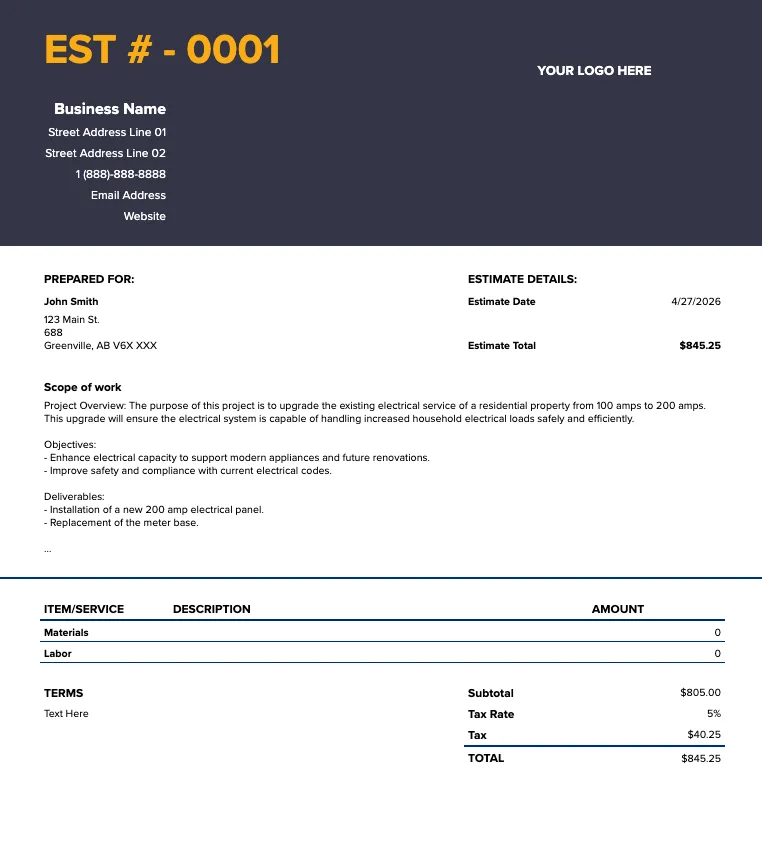
| Client-facing document | Not included | Yes. Customer Estimate tab, PDF-ready |
| Best for | One-off jobs, quick estimates, getting started | Repeat jobs, multiple clients, a full estimating workflow |
Both calculate markup, margin, and totals automatically.
Get both templates free. Enter your email at the top of the page
The simple electrical estimate template
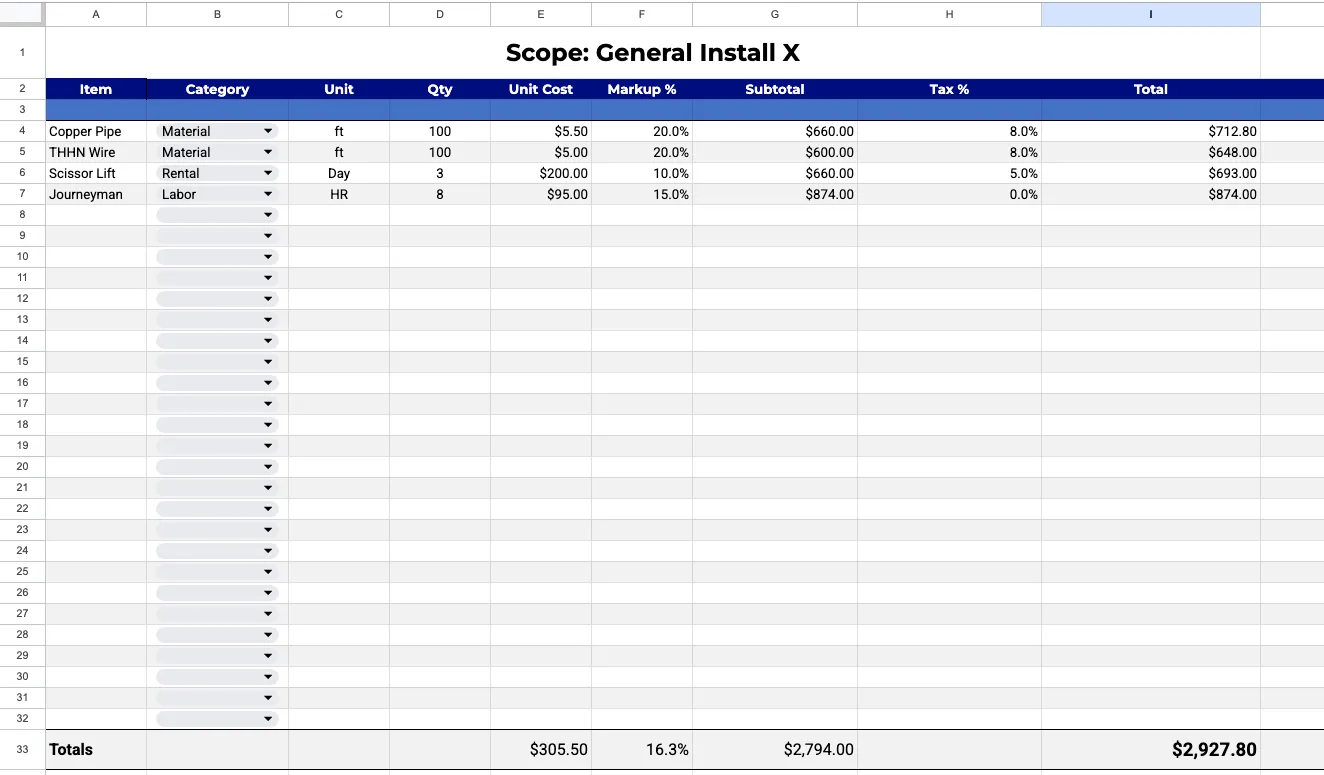
One sheet. No setup. Add your line items, set your markup and tax rate per line, and the totals calculate automatically.
Columns: Item, Category (Material / Labor / Rental), Unit, Qty, Unit Cost, Markup %, Subtotal, Tax %, Total. The bottom row shows your weighted average markup and job total.
This is the electrician estimate template for contractors who need to price a job quickly, estimate a one-off scope, or get familiar with the workflow before building out a full Price Book.
The simple template does not include a client-facing proposal document. If you need a formatted quote to send to clients, see the free electrical quote template.
The in-depth electrical estimate template
This is not a blank spreadsheet with column headers. The template is structured across four tabs, each doing a specific job in your estimating workflow.
| Tab | What it does | Key takeaway |
|---|---|---|
| Tab 1: Instructions | A quick-start guide that walks through how each tab connects. | Read it once, then set it aside. The template is designed to be self-explanatory after the first job. |
| Tab 2: Price Book | Your materials and labor items live here. Enter each item once: the name, your cost, and your markup percentage. This is your reusable reference for every estimate you build. Update a price when it changes and every future estimate pulls the current number automatically. | You build the Price Book once. You stop repricing from memory on every job. |
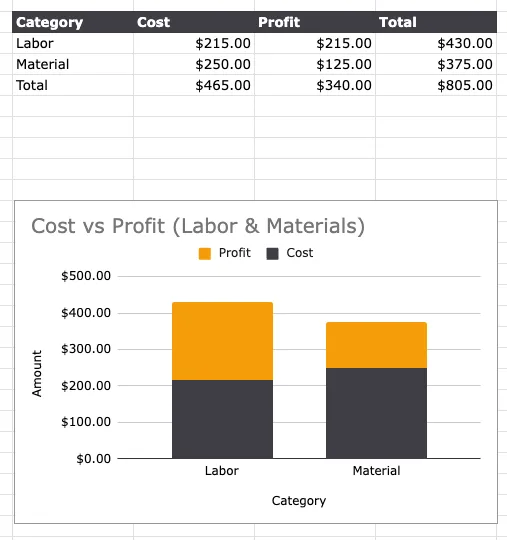
| Tab 3: Estimate Items | The working estimate for a specific job. Select items from your Price Book and cost and markup auto-populate from what you entered there. Add a description and quantity, and the amounts calculate automatically. The spreadsheet builds your running total as you go, and your margin updates with every line. | You see your profit before you finalize the price. No manual math required. |
| Tab 4: Customer Estimate | The Customer Estimate tab updates automatically based on what is in your Estimate Items. You customize the header with your logo, company details, and customer information, then fill in the scope of work and your terms. Export the Customer Estimate tab as a PDF to send to clients. It looks like you paid someone to design it. | Most estimate templates stop at a price table. This one gives you a document that wins jobs. |
If you want the same output but with a PDF that auto-generates from your estimate and carries your branding throughout, that is what VoltPro does. The template is the free starting point. VoltPro is the version you do not have to maintain.
How to build an accurate electrical estimate (step-by-step)
An accurate estimate starts before you open a spreadsheet. The six steps below apply whether you are bidding a 200-amp panel upgrade or a full tenant fit-out.
Step 1: Document the full scope of work
Walk the job or review the drawings. Write down every circuit, panel, device, fixture, and conduit run involved. Note building type, ceiling height, access conditions, and code requirements.
About 8 in 10 electrical contractors report receiving incomplete or incorrect plans and specs.[1] Identifying the gaps before you price is what separates an estimate that holds from one that bleeds margin mid-project.
On commercial jobs: confirm Division 26 scope, check for addenda, and clarify what the GC expects included versus what other trades own. A verbal assumption about scope is how disputes start.
Step 2: Build your material takeoff
Focus on the major materials: wire (by gauge and run length), conduit (type and diameter), panels, disconnects, devices, breakers, and fixtures. Small consumables are typically estimated as a percentage of majors or rolled into one line. Counting every coupling and connector on a commercial job costs more time than it saves.
The discipline is catching what moves the number. Missing a 50-amp disconnect or an uncounted subpanel erodes margin. Missing a bag of wire nuts does not.
Verify pricing against recent supplier invoices. Copper and brass mill shapes rose 12.3% year-over-year in early 2025.[2] Reusing pricing from a job you bid six months ago is a reliable way to underprice the next one.
Step 3: Calculate your labor hours by task
Break the job into discrete tasks: rough-in, trim, panel work, low-voltage, testing, cleanup. Assign hours based on your crew's actual production rates on similar work. Include travel time, mobilization, and site conditions that slow production.
Then check your labor rate. Benefits alone represent 32.8% of total compensation for construction workers, per Bureau of Labor Statistics data from March 2025.[4] Add payroll taxes and insurance and the fully loaded cost runs 46 to 48 cents per dollar of wages.
Step 4: Apply markup and verify your margin
Set your markup on materials and labor in your estimate. The spreadsheet calculates your running margin as you go.
16.7%
actual margin on a 20% markup
A contractor targeting 20% margin who applies 20% markup earns 3.3% less on every job. On a $30,000 estimate, that is $990 left on the table.
A common baseline: 10% overhead plus 10% profit target requires a 25% markup on direct costs.[5] Use the free markup and margin calculator to find the exact number for your target.
Step 5: Add permits, inspections, and contingency
These are not optional line items. They are real costs and belong in every estimate. Permit and inspection fees vary by jurisdiction. The inspection also requires your crew on-site — that is scheduled labor time. Build it in and you recover it.
Add a contingency of 5 to 10 percent for unforeseen conditions. Hidden runs, existing wiring that does not match the drawings, a GC who reschedules your work. On commercial jobs these are not edge cases. They are the job.
Step 6: Review your margin before you send
Open Tab 3 and check your gross margin percentage before you send anything. This takes sixty seconds.
Specialty trade contractors report net profit margins between 6.9% and 8.5%, with top performers reaching 11.9%.[6] Those numbers are measured after the job. The margin review in your estimate is when you can still do something about it.
43% of contractors reported at least one project canceled or scaled back due to cost increases in the previous six months, per a 2025 AGC survey.[3] Accurate estimates do not prevent price pressure. They ensure you know your floor before you negotiate.
Electrical estimate sample: a residential service upgrade
The example below is based on a real service upgrade estimate built in VoltPro. Item names and prices have been paraphrased, but the structure, quantities, and dollar amounts reflect an actual job.
Job: Residential service upgrade to 200A. Single-phase overhead service, existing house, permit and utility inspection required. Includes new panel, main disconnect, meter socket, service entrance cable, grounding system, and breakers.
A note before the numbers: Most contractors send a lump sum number to clients. The line-item breakdown below is for your own margin check, not the client-facing document. The Customer Estimate tab gives you control over how much detail the customer sees. The math behind it is yours to keep.
Material takeoff (Price Book → Estimate Items)
Items grouped by category. These are the actual line items from the job, grouped for readability.
| Category | Extended (at 15% markup) | |
|---|---|---|
| Main service equipment | $650 | |
| Service entrance | $575 | |
| Grounding system | $275 | |
| Branch circuit breakers | $250 | |
| Miscellaneous | $250 | |
| Materials total | $2,000 | |
Note: materials priced at 15% markup over supplier cost.
Labor and fees (Estimate Items)
| Line item | Amount |
|---|---|
| Labor (14 hrs at $100/hr loaded rate) | $1,400 |
| Permit and inspection fees | $200 |
| Labor and fees total | $1,600 |
Estimate summary
| Materials | $2,000 |
| Labor | $1,400 |
| Inspection | $200 |
| Total | $3,600 |
What this estimate reveals about margin
This example estimate illustrates something worth paying attention to. The contractor applied 15% markup to materials (yielding 13% gross margin on materials) and zero markup on labor and inspection. The overall gross margin on the job is roughly 7%.
That is below the 20–25% gross margin most trade contractors target. The math shows exactly where: labor is billed at cost, with no margin built in beyond the hourly rate. Whether that hourly rate already includes overhead and profit is the question.
A 25% markup across the board on this job's direct costs would have produced a gross margin of 20% and an estimate total closer to $4,150–$4,200. The job still gets quoted. The contractor knows their floor.
This is the discipline the template is designed to enforce: see the margin before you send. This estimate's structure is right. The markup decision is the contractor's call to make, and with a working estimate, it is a visible one.
Service upgrades at this scope typically run $3,000–$5,500 in most US markets. Complexity factors that push the price higher: underground service, utility company cut-in requirements, meter socket changes requiring utility coordination, temporary power during cutover, or older homes with issues that surface during inspection.
Want this without the spreadsheet?
Try VoltPro free5 estimating mistakes that shrink your margins
An industry estimate puts contractor estimating errors at $273 billion annually.[7] Most of those losses are not math errors. They are process gaps that repeat on every job.
1. Using stale material pricing
Copper and brass mill shapes rose 12.3% year-over-year as of January 2025.[2] Steel conduit prices rose 13.1% year-over-year between August 2024 and August 2025. Aluminum hardware ran 22.8% over the same period.[3]
If you are pulling material costs from a bid you did six months ago, you are pricing off numbers that may have moved significantly. Verify pricing against current supplier invoices before you lock in a number. The Price Book in this template makes that faster. One update to a line item propagates to every future estimate.
2. Confusing markup with margin
This is the most common pricing error in the trades, and it is expensive in proportion to how simple it is.
Markup is calculated on cost. Margin is calculated on the selling price. A 20% markup on a $10,000 direct cost gives you a $12,000 selling price. Your $2,000 profit is 16.7% of $12,000, not 20%. You are running a 16.7% margin, not 20%.
$1,650
lost per $50k estimate from the markup/margin confusion
For a contractor bidding regularly, this is a meaningful number to be systematically underestimating.
Set your markup to produce the margin you need, not the number that feels right. Full breakdown: markup vs. margin for contractors.
3. Incomplete material takeoffs
A missed disconnect, one uncounted circuit, a short conduit run. Each one looks like a rounding error at estimate time. Each one carries its own labor, overhead, and markup that you will not recover. The compounding effect of small omissions across a full commercial job can eliminate your contingency before the job is half done.
Build your takeoff against the drawings (or your site notes), not from memory. The Price Book in Tab 2 is designed to prompt this discipline. If an item is not in the Price Book, it is a gap worth investigating.
4. Skipping permits and contingency
Permit fees are not optional costs you absorb. They belong in your estimate as explicit line items. So does the inspection, which requires your crew on-site on a schedule you do not control.
Add a contingency of 5 to 10 percent on every commercial job. Unforeseen conditions, a GC rescheduling your work, existing conditions that do not match the drawings. These are not exceptional circumstances. They are standard commercial job reality.
5. Sending without a margin check
Most contractors calculate a total and send it. The margin review happens after the job, when the actual hours are in and the final materials cost is reconciled. By then, the price is locked and the margin is what it is.
Sixty seconds before you send can catch an underbid before it becomes your problem for the next two months. The template calculates your margin automatically. Use it.
VoltPro calculates your margin automatically — no markup/margin confusion.
Start estimatingWhy professional electrical estimates win more commercial jobs
Commercial clients (property managers, facilities operators, GCs) read multiple estimates. The person reviewing your bid is comparing it against two or three others. A single number on a piece of paper, or a rough PDF from a Word doc template, tells them something about how you work.
A line-item estimate with scope of work documentation, a terms section, and your company branding says something different.
Transparency wins on commercial jobs. Commercial clients want to understand what they are paying for. Itemized materials, labor by task, permits as a line item. This is not over-sharing. It is the standard. Clients who can see where the money goes say yes faster and dispute less.
Detail separates you from the one-number bidders. Most electrical contractors submit a price and a paragraph of scope. A structured estimate with clear section breaks, line items, and a professional layout reads as a more serious, organized operation. That perception matters when a GC or property manager is choosing who to bring back on the next job.
The estimate sets the change order baseline. On commercial work, scope changes. When your original estimate is itemized and documented, the change order conversation starts from a clear reference point. "Here is the original scope, here is what changed, here is the price for the delta." That is a professional conversation. When the original estimate is a rough number, every scope change becomes a negotiation from uncertainty.
You protect your margin before the job starts. An estimate that forces you to account for materials, labor, overhead, permits, and contingency as separate line items is an estimate with nowhere for a cost to hide. That discipline is the difference between a contractor who runs a predictable margin and one who finishes jobs wondering why the numbers do not add up.
VoltPro takes this further. The template gives you the structure. VoltPro auto-generates a branded PDF proposal from your estimate, stores every job in one searchable place, and handles change orders in two clicks. The upgrade is there when the spreadsheet stops being enough.
Frequently asked questions
Resources
- National Electrical Contractors Association. "2024 Profile of the Electrical Contractor Reveals Industry Growth and Shifting Trends." PR Newswire, July 16, 2024.
- Associated General Contractors of America. "Prices for Nonresidential Construction Materials and Services Rise 0.8 Percent in January, Contractors Brace." AGC, February 13, 2025.
- Associated General Contractors of America. "Construction Material Costs Continue to Accelerate in August amid Extreme Price Hikes in Steel, Aluminum." AGC, September 10, 2025.
- Bureau of Labor Statistics. "Employer Costs for Employee Compensation — March 2025." BLS ECEC, June 2025 release (USDL-25-0958).
- Pedroza, D. "General Contractor Profit Margin: 2025 Data Report," Siana Marketing (citing CFMA Financial Benchmarker, JMCO Performance Benchmarks, and IBISWorld).
- CFMA. "2024 Construction Financial Benchmarker" (covering fiscal year 2023), Construction Financial Management Association. Data confirmed via RedHammer analysis.
- McCormick Systems. "Most Common Construction Estimating Mistakes," citing National Cooperative Highway Research Program data. The $273 billion figure is directional; the primary NCHRP document is unverified.
Still looking for an easier way?
VoltPro replaces the spreadsheet with automatic material price tracking, reusable assemblies, and professional PDF estimates built for electrical contractors.
Start estimating