
Free Tool
Free electrical quote templates for professional contractors
Once you have done the math, you need a document that looks like it came from a professional operation. These free electrical quote templates are built for that moment.

What is in the template
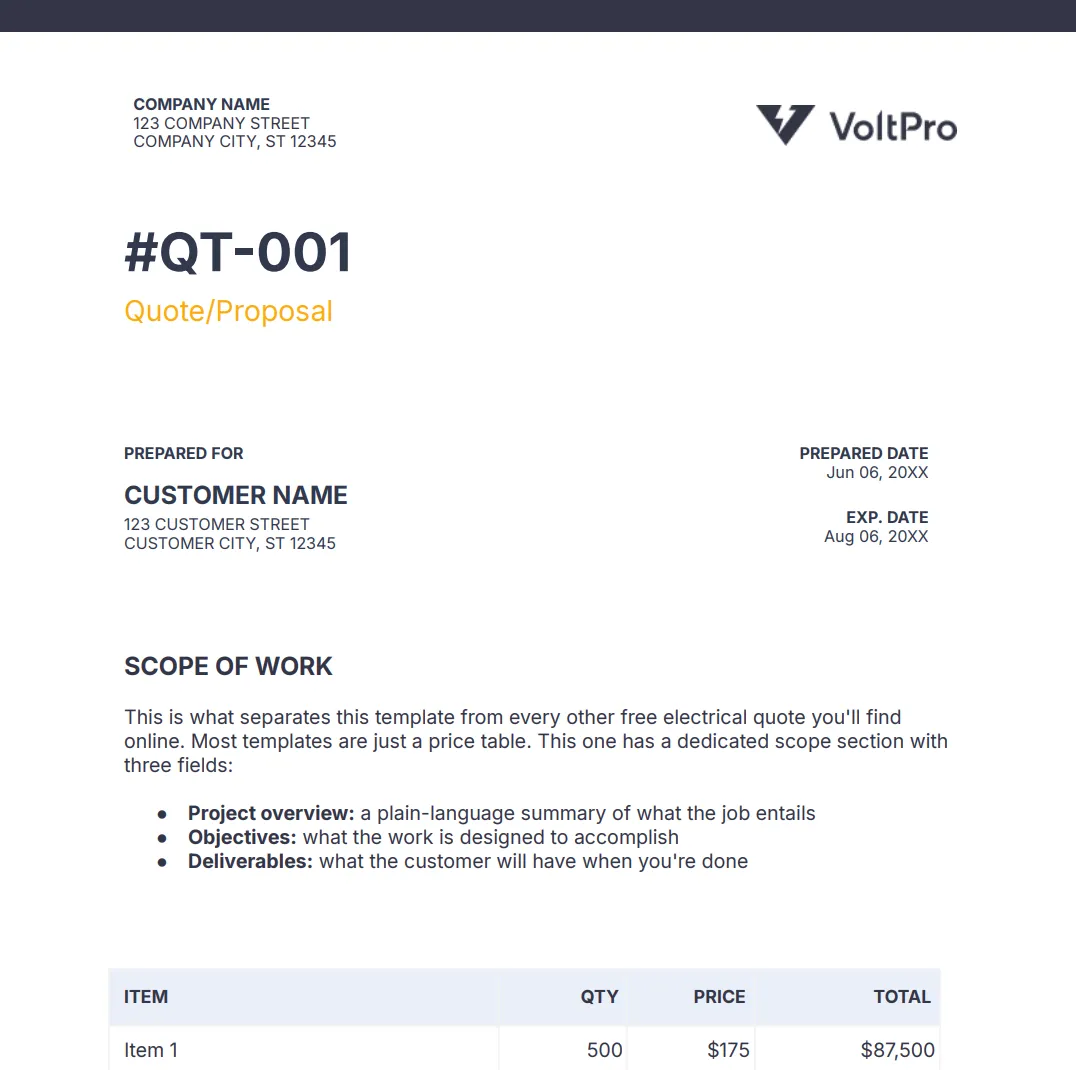
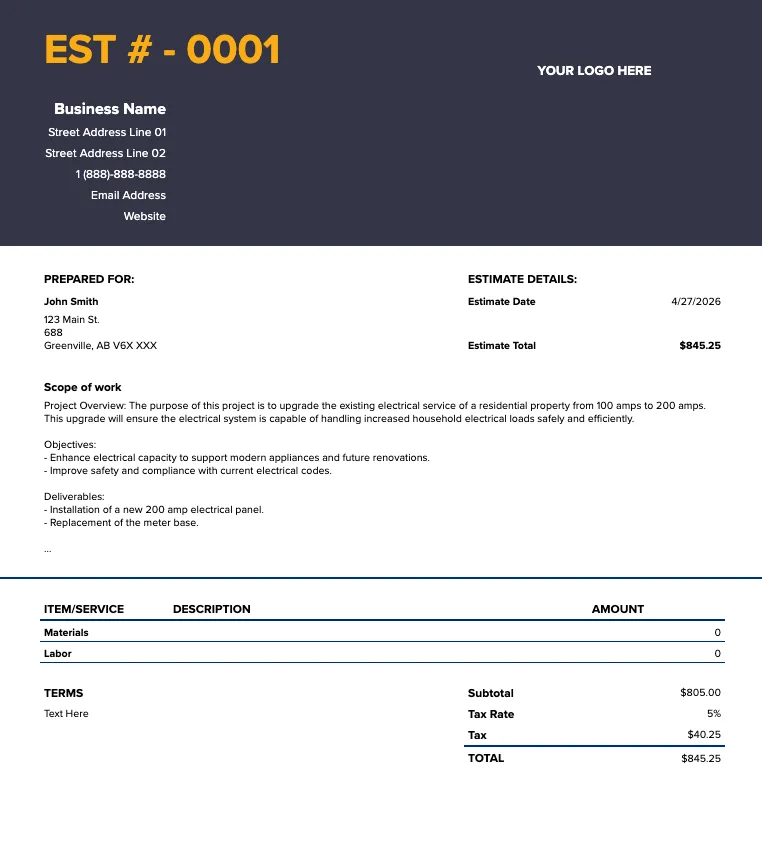
The quote template is a single client-facing document. Every section is designed to give commercial clients what they need to approve your price and start the job.
| Section | What's included |
|---|---|
| Header section | Estimate number (EST #), your business name and address on the left, company logo placeholder on the right, dark navy professional design |
| "Prepared For" section | Customer name and address |
| Estimate details | Date, estimate total |
| Scope of work section | Three fields: Project overview (a plain-language summary of what the job entails), Objectives (what the work is designed to accomplish), Deliverables (what the customer will have when you're done) |
| Line items table | Three columns: Item/Service, Description, Amount. Materials and labor appear as separate categories. Clean, scannable, easy for the client to follow. |
| Terms section | A text field for payment terms, warranty language, or any job-specific conditions |
| Totals | Subtotal, Tax Rate % (editable), Tax (auto-calculated), TOTAL (auto-calculated) |
VoltPro branding appears in the footer. The rest is yours. To use it: customize it in the spreadsheet, then export as PDF to send.
Get the template free. Enter your email at the top of the page
What makes a professional electrical quote
Most quotes that go out to commercial clients are missing at least one of these. Before you send anything to a property manager, GC, or facilities contact, check your document against this list.
1.Your company name and branding
The document should identify who it is from. A logo, your business address, and a consistent layout signal that you run a real operation. Clients who compare multiple quotes notice when one looks like a business and one looks like a spreadsheet.
2.A scope of work
Price without scope creates disagreements. When the customer knows exactly what is included, there is less room for disputes after the job starts. For commercial work especially, scope documentation is expected. A one-sentence project description is not enough.
3.Exclusions
A scope of work tells the client what you are doing. Exclusions tell them what you are not. That distinction is what protects you from scope creep and change order disputes. Common electrical exclusions include:
- ●Patching or painting after electrical rough-in
- ●Low voltage or data cabling (unless specifically included)
- ●Utility company fees, meter set, or service connection charges
- ●Work outside the scope shown on the agreed drawings
- ●Demolition beyond what is needed for the electrical work
- ●Hazardous material remediation
If it is electrical, either include it in your estimate or exclude it in your scope letter. Anything left unaddressed is an argument waiting to happen.
4.A payment schedule
Payment terms tell the client when money is due. A payment schedule tells them how the job is structured financially from start to finish. On commercial work, that structure matters. Standard payment schedule on a larger job:
- ●Deposit upfront (10 to 30% on larger jobs)
- ●Progress payments tied to milestones (rough-in completion, trim, final)
- ●Retainage on GC work (5 to 10%), typically released at substantial completion
- ●Final payment on substantial completion or certificate of occupancy
Without a payment schedule, commercial jobs can stretch your cash for months. Construction contractors collect payment in more than three months on average.[4] A written schedule, agreed to before the work starts, is the clearest protection against that.
5.Itemized line items
Labor and materials should be separate, visible line items. On commercial jobs, clients often need to get budget approval, and a visible breakdown makes that process easier. It also makes change orders cleaner. When scope expands, you are adjusting specific line items rather than revising a lump sum with no backstory.
6.Terms
When is payment due? What happens if the scope changes? What is your policy on job delays outside your control? Terms do not need to be long, but they need to be there. A quote without terms is a verbal agreement dressed up as a document.
7.An approval or signature line
Adding a signature line converts the quote into a binding acceptance once the client signs it. This is common on direct-to-owner commercial work. For GC bids, the GC typically issues a purchase order separately, so a signature line is less standard there.
8.Tax and totals
Every number the client sees should roll up to a clear, unambiguous total. Subtotal, tax, total. In that order, auto-calculated so there are no arithmetic errors.
What a professional scope of work looks like
The scope section is where most quotes fall short. A sentence or two is not enough for a commercial client who needs to get budget approval or sign off with a facilities director. Here is what a filled-in scope looks like on a real commercial job.
Project: Office suite electrical fit-out, Suite 204, 3,100 sq ft tenant build-out
General Contractor: [GC Name]
Drawings: Drawing Set A-1 through E-6, Revision 2, dated March 14, 2026
Project Overview
Furnish and install all electrical systems for a new tenant fit-out in Suite 204 of a Class B commercial office building. Work to be performed per the electrical drawings and specifications referenced above.
Objectives
- - Provide a complete, code-compliant electrical installation ready for occupancy inspection
- - Coordinate panel capacity and circuit allocation with the building's existing 400A three-phase service
- - Meet the tenant's lighting and power requirements per the approved construction documents
Deliverables
- - New 42-circuit 200A sub-panel fed from the building main distribution board
- - Rough-in and trim for 24 duplex receptacles and 8 dedicated 20A circuits (server room, break room, copier stations)
- - Lighting installation per fixture schedule: 36 recessed LED troffers and 4 exit/emergency fixtures
- - Final connections to HVAC equipment per mechanical contractor's schedule
- - Final inspection and certificate of completion
Exclusions
- - Patching or painting of drywall after rough-in
- - Low voltage, data, or structured cabling (by others)
- - Utility company coordination or service connection fees
- - Any work outside Drawing Set A-1 through E-6, Revision 2
That level of detail does two things. It shows the client you understand the job. And it draws a clear line around your scope before work begins, so change orders are additions to a defined baseline rather than arguments about what was included.
VoltPro generates this proposal document automatically from your estimate.
Try VoltPro freeQuote, estimate, and proposal: what each word means
These three words get used interchangeably in the trades, but they mean different things. The difference matters when you are working with commercial clients.
| Term | Definition |
|---|---|
| Estimate | An approximate projection of costs before the full scope is confirmed. The price may change as the job scope gets clearer. Estimates are common in the early stages of a project, when you are working from a walkthrough rather than a full set of plans. If you need to build one, the free electrical estimate template covers both a simple and in-depth version. |
| Quote | A fixed price for a defined scope. When you send a quote, you are committing to that number for that scope. The scope should be clearly written down because that is what the price is tied to. Standard electrical quotation format includes: scope, exclusions, line items, terms, and a total. |
| Proposal | A quote packaged for a decision. It includes company branding, a clearly written scope, itemized pricing, terms, and often a signature line. A proposal is the finished document. A quote is the pricing inside it. |
The template on this page is a quote format built to function as a proposal. It has the scope, the line items, the terms, and the branding. That combination is what closes jobs. Before you send any quote, confirm your numbers are right with the markup and margin calculator. For a deeper look at how estimating tools and proposal software differ, see estimating software vs. proposal software.
Using this template for commercial electrical work
Every other free electrician quote template online is built for residential work: service calls, panel swaps, ceiling fans. The framing, the examples, and the line items all assume a homeowner on the other end.
Commercial work is different. Your client is a property manager, a facilities director, or a GC. They see multiple quotes and know what professional documentation looks like.
This template is built for that context. The scope of work section exists because commercial clients need to approve scope before they approve price. The terms section exists because commercial jobs have payment cycles, not just invoices.
If you are pricing a commercial office fit-out, a panel upgrade for a multi-tenant building, or a service entrance for new construction — this is the format they expect.
The template works for residential jobs too. The scope and exclusions sections are just more important on the commercial side.
Frequently asked questions
Resources
- ElectricalEstimating101.com. "The Scope Letter." Practitioner guidance on what an electrical contractor's proposal should contain when bidding to a GC.
- Joist. "How to Write a Contractor Proposal." Industry practitioner guide covering required proposal elements.
- Bureau of Labor Statistics. "Employer Costs for Employee Compensation — March 2025." BLS ECEC, June 2025 release (USDL-25-0958). Primary: bls.gov/news.release/archives/ecec_06132025.pdf
- Commerce Bank. "U.S. Construction Industry Report." August 2025. Contractors collect payment in more than three months on average.
- CFMA. "2024 Construction Financial Benchmarker." Construction Financial Management Association. Specialty trade contractors averaged 6.9% net income.
Want the estimate math done for you too?
VoltPro builds the proposal automatically from your estimate. Add line items, set your markup, and get a branded PDF with your logo. No manual entry per client.
Start estimating